Category: Insights

  • How to start an employee resource group that lasts

    How to start an employee resource group that lasts

    Belonging

    "We launched an employee resource group with a lot of energy. 6 months later, the same 3 people come to every meeting."

    Leaders tell me this often. The idea was right. The group needed a structure to keep going.

    An employee resource group, or ERG, brings together employees who share an identity or a purpose. A strong ERG gives your company 3 things:

    • People who feel they belong
    • New leaders who grow by running the group
    • Talent that stays longer

    What the research says

    • A 2023 study of ERG leaders describes ERGs as a recruiting and retention tool.
    • Members gain career growth, friendships and a sense of purpose.
    • SHRM reports that ERGs create a sense of belonging and keep people engaged.

    What I have seen

    I have founded and led employee resource groups inside 2 global companies. I led a women's network across 20 offices in North America, and its membership grew by 220%.

    One moment stays with me. During the pandemic, I saw that my company had a group for women and a group for race. I saw that women of colour needed a space of their own. So I created a monthly call for them.

    • More than 180 people joined
    • It ran on a simple, regular rhythm
    • It gave people a place to be seen and supported

    5 steps to an employee resource group that lasts

    1. Start from a real need

    • What to do: before you launch, talk to 10 to 15 people who would join. Ask what they need at work.
    • Example: "What would make this company a better place for you to grow? What did you wish you had when you joined?"
    • Why it works: a group built on a real need keeps its members long after launch day.

    2. Find an executive sponsor who shows up

    • What to do: ask 1 senior leader to sponsor the group, join a few meetings a year, and open doors.
    • Example: "Can you join our quarterly meeting, and bring 1 idea with us to the leadership team each year?"
    • Why it works: a sponsor gives the group visibility, budget and a voice where decisions are made.

    3. Protect a regular rhythm

    • What to do: choose 1 recurring moment, like a monthly call, and keep it on the calendar.
    • Example: "Last Thursday of every month, 45 minutes, online, open to everyone."
    • Why it works: consistency builds trust. People come back when they know the group is there.

    4. Share the leadership

    • What to do: build a small leadership team with clear roles, and rotate the roles every year.
    • Example: "1 lead, 1 events owner and 1 communications owner, with new names each year."
    • Why it works: the group stays strong when 1 person gets busy, and more people grow as leaders.

    5. Connect the group to the business

    • What to do: link the group to 1 or 2 company goals, like recruiting, onboarding or retention, and report back once a year.
    • Example: "This year, our members welcomed every new hire in their first month, and reviewed 2 people policies."
    • Why it works: leadership sees the value, the group gets support, and the volunteers get recognized.

    Your takeaway for this week

    • If your company has an ERG, ask its leads: "What would keep this group strong a year from now?"
    • If you are starting fresh, have 3 conversations with people who might join.
    • Listen for the need they mention most.

    Ready to build it?

    I design and facilitate workshops for organizations on starting and running an employee resource group that lasts, in English or French. I also advise leaders on building workplaces where people want to be, belong, feel seen and grow.

    Let us talk: samiradiallo.com/workshop-speaking

    Sources: Schlachter, Rolf and Welbourne, Compensation and Benefits Review, 2023; SHRM, "Employee resource groups create a sense of belonging.

    Samira Diallo

    About the author

    Samira Diallo

    Samira Diallo is a bilingual (French and English) people strategy advisor, facilitator and speaker based in Toronto. She spent 15+ years in global tech consulting at Capgemini and Oracle, leading technology projects and the people side of the teams delivering them. Today, she helps companies keep their best people and coaches professionals building the career that works for them.
    ← All insights

  • How to spot the people on your team who are waiting to be noticed

    Managers

    “I did not know she wanted more.”

    A manager says this after a strong employee resigns. People who wait to be noticed may not say it out loud. They do good work, they stay quiet in meetings, and they wait.

    What the research says

    Gallup and Workhuman studied employees who get both feedback and recognition from their manager at least once a week. 61% of them are engaged, compared with 38% of those who get weekly feedback and less frequent recognition. These figures come from survey data and show a link.

    Source: Gallup, “Organizations Can Redefine Feedback by Including Recognition” (gallup.com/workplace/651812).

    What I have done

    I led a remote team of 40+ consultants. I paired each new hire with an experienced colleague for the first weeks, a buddy, so that new people had someone to ask the small questions. People settled in faster, and they stayed.

    5 habits to notice people

    1. Ask 1 question in every 1 on 1

    • What to do: Ask about work the person did that you may have missed.
    • Example: “Tell me about something you did recently that I might have missed.”
    • Why it works: It shows you care about their work and gives them room to share what they might be too shy to say.

    2. Name specific work, every week

    • What to do: Once a week, tell 1 person exactly what they did and why it mattered.
    • Example: “Your summary on Tuesday saved the client call. The decision took 5 minutes because of it.”
    • Why it works: Specific recognition shows you were paying attention, and it is the weekly rhythm that Gallup links with higher engagement.

    3. Make room for the quiet voices

    • What to do: Ask the quiet person directly, or collect ideas in writing before the meeting.
    • Example: “Send me 1 idea by Thursday, and I will bring it to the meeting.”
    • Why it works: You hear ideas you were missing.

    4. Ask about growth

    • What to do: Once a quarter, ask what the person wants to do more of.
    • Example: “If you could pick 1 project next quarter, what would it be?”
    • Why it works: You learn what they want before they look elsewhere.

    5. Give every new hire a buddy

    • What to do: Pair each new person with a colleague 1 or 2 steps ahead, and check in with both after the first month.
    • Example: “Your buddy for the first 6 weeks is a colleague on the team. Ask your buddy the small questions.”
    • Why it works: The buddy is close enough to remember being new, so the small questions get asked.

    Your takeaway this week

    Use habit 1 in every 1 on 1. Write down what you hear.

    Copy this: the 1 on 1 question card

    1. Tell me about something you did recently that I might have missed.
    2. What do you want to do more of next quarter?
    3. What has not come up in meetings that I should know?
    4. Who helped you this week?
    5. What do you need from me before we meet again?

    Pick 1 or 2 questions per meeting, and write down the answers.

    Samira Diallo

    About the author

    Samira Diallo

    Samira Diallo is a bilingual (French and English) people strategy advisor, facilitator and speaker based in Toronto. She spent 15+ years in global tech consulting at Capgemini and Oracle, leading technology projects and the people side of the teams delivering them. Today, she helps companies keep their best people and coaches professionals building the career that works for them.
    ← All insights

  • Your first performance process: where to start

    Your first performance process: where to start

    Performance

    "Our team keeps asking how they are doing. Where do we start with reviews?"

    Growing companies often reach this moment between 15 and 50 people. Your team wants 3 things:

    • To know what great work looks like in their role
    • To hear how they are doing, regularly
    • To see a path to grow with you

    Performance management gives them all 3. It starts simple: clear expectations, a regular rhythm, and managers who know what to say.

    What the research says

    • Gallup found that only 14% of employees strongly agree their performance reviews inspire them to improve.
    • Only 2 in 10 feel their performance is managed in a way that motivates them.
    • What motivates people is simple, regular and honest feedback.

    What I have seen

    In 15 years in tech consulting, I have designed how teams develop, coach and promote their people.

    On a team of 40+ consultants, I coached managers through development plans, improvement plans and promotion decisions. The results:

    • Every manager followed the same clear steps to develop their people
    • 87% of the team was promoted from within
    • The company kept its talent and saved on hiring

    For a growing technology company, I built performance management into the full people function, on tools the team already used. The team started right away, using what they already had.

    5 steps to your first performance process

    1. Write down what great looks like

    • What to do: for each role, write 3 to 5 clear expectations people can check themselves against.
    • Example: "A senior consultant leads client meetings, delivers on time, and coaches 1 junior colleague."
    • Why it works: people meet expectations they can see. This step answers most of their questions.

    2. Set a simple rhythm

    • What to do: a monthly 1 on 1 for every person, and a short review every 6 months.
    • Example: "First Tuesday of the month, 30 minutes. In April and October, a 1 page written review."
    • Why it works: regular feedback feels normal and useful. People adjust as they go.

    3. Give managers the same 3 questions

    • What to do: ask every manager to use the same questions in every review.
    • Example: "What went well? What would make the next 6 months better? What support do you need from me?"
    • Why it works: reviews are fair across teams, and new managers have a clear place to start.

    4. Prepare managers for the hard conversation

    • What to do: before the first cycle, run a short session on how to tell someone they are below expectations, and what happens next.
    • Example: "Here is what I expected. Here is what I saw. Here is what needs to change by next month, and here is how I will support you."
    • Why it works: the hardest conversation is often the most important one. Practice makes it clear and kind.

    5. Start with the tools you already have

    • What to do: use a shared document or the platform your team already works in. Add software later, when you need it.
    • Example: "1 template per role in the shared drive, and a calendar reminder for every 1 on 1."
    • Why it works: people adopt what is simple. The habit comes first, the tools follow.

    Already running reviews? Read How your team can know where they stand before review day.

    Your takeaway for this week

    • Pick 1 role on your team.
    • Write the 3 expectations that define great work in that role.
    • Share them with the person in that role and ask: "Is this how you see your job too?"

    Ready to build it?

    I advise growing tech companies on their people processes, including performance management, as a fractional people leader or on a defined project. I also design and facilitate workshops for managers on the performance conversations that matter most.

    Let us talk: samiradiallo.com/people-strategy

    Sources: Gallup, "Why your performance management is broken.

    Samira Diallo

    About the author

    Samira Diallo

    Samira Diallo is a bilingual (French and English) people strategy advisor, facilitator and speaker based in Toronto. She spent 15+ years in global tech consulting at Capgemini and Oracle, leading technology projects and the people side of the teams delivering them. Today, she helps companies keep their best people and coaches professionals building the career that works for them.
    ← All insights

  • Before you replace people with AI, read this

    Before you replace people with AI, read this

    AI and the workforce

    Some companies let people go to make room for AI, then hire them back a few months later. AI can do tasks, but it cannot replace the trust, the judgment and the knowledge your people carry.

    What the research says

    • In 2025, Orgvue surveyed "1,000 C-suite executives and senior decision makers at medium and large organisations." It found that "39 percent of leaders made redundancies after introducing AI." And: "Of these, 55 percent acknowledged they had made mistakes in their redundancy choices."
    • Klarna began replacing its human staff with AI. In 2025, its CEO said its customers "want to speak to actual humans," and the company rehired some of its customer service staff.

    What I have seen

    For 15 years at Capgemini and Oracle, I ran technology programs and led the people who delivered them.

    I started in technology, but the people side is what I came to love. That taught me something: a new tool only works when people use it. You still need the human side, the change management. AI makes it even more important.

    5 steps to bring AI into your team without losing your people

    1. Map the work first

    List the tasks AI can do, and the tasks that still need a person. Most jobs are a mix of both.

    2. Decide who stays, beyond cost

    Look at what people know, who they know, and how they can grow. Ask: "Who do clients call first?"

    3. Lead the change, not only the launch

    Explain why you are bringing in AI, and what changes for each team. People accept what they understand.

    4. Help new people learn

    When AI does the beginner tasks, pair each new hire with an experienced colleague, and review real work together every week.

    5. Keep people where trust matters

    Let AI answer simple questions. Keep a person for every complaint and every important client.

    Your takeaway for this week

    • If your company is bringing in AI, ask your leaders: "What knowledge would we lose if this job disappeared?"
    • Write down the 3 tasks in your own job that only a person can do.

    Want help bringing AI into your team without losing your people?

    Let us talk: samiradiallo.com

    Sources: HR Review, "AI regret: over half of firms say their redundancies were a mistake", 2025; Information Age (ACS), "Companies backtrack after going all in on AI", 26 May 2025.

    Samira Diallo

    About the author

    Samira Diallo

    Samira Diallo is a bilingual (French and English) people strategy advisor, facilitator and speaker based in Toronto. She spent 15+ years in global tech consulting at Capgemini and Oracle, leading technology projects and the people side of the teams delivering them. Today, she helps companies keep their best people and coaches professionals building the career that works for them.
    ← All insights

  • What changes when a founder builds the people side

    What changes when a founder builds the people side

    People strategy

    "Our company grew fast. Now every people problem comes back to me."

    Founders of growing tech companies say this to me often. The questions pile up:

    • Who do we hire next, and who decides?
    • What do I say to the manager who is struggling?
    • Why did a great person just resign?

    At 8 people, the founder can answer all of it. At 25 or 40 people, it fills the whole week. The founder has less time for clients and for the product.

    Building the people side means each of these areas has a clear process and an owner: hiring, onboarding, managers, performance and decisions. The company keeps running well as it grows, and the founder gets their time back.

    What the research says

    • Gallup found that managers account for at least 70% of the difference in engagement between teams.
    • Your people's experience depends mostly on the person they report to.
    • When managers have a simple structure to follow, they solve problems themselves.

    What I have seen

    In 15 years in tech consulting, I have led the people side for teams of every size, up to people operations for more than 2,000 employees across 20+ offices.

    One example. A technology company had teams in 5 countries, on 3 continents, and was starting from zero. Each country had its own way of hiring and welcoming people.

    I designed and delivered the full people function:

    • 1 hiring process for all 5 countries
    • 1 onboarding experience, so every new person knew what success looked like on day 1
    • Performance management, engagement tracking and offboarding, on tools the team already owned

    The results:

    • The founder got 15 to 20 hours back every week
    • Hiring became faster and the same in every country
    • The team owned the system and ran it with confidence

    On another team of 40+ consultants, the people system I built kept 95% of the team.

    5 changes when the people side is built

    1. Hiring follows a clear process

    • What to do: write every step from job post to offer, and who decides at each step.
    • Example: "Every role has 3 interviews. The hiring manager makes the decision. The founder meets final candidates for senior roles."
    • Why it works: the founder steps out of most hires, and every candidate has the same strong experience.

    2. Every new person starts strong

    • What to do: create 1 plan for the first 90 days, the same in every location.
    • Example: "Day 1, you meet your buddy. Week 1, you know your goals. Day 90, we review together."
    • Why it works: people decide early if they made the right choice. A strong first 90 days keeps them.

    3. Managers handle the hard conversations

    • What to do: give managers a short guide on feedback, on someone below expectations, and on when to involve leadership.
    • Example: "Have the conversation, write down what you agreed, and check in 2 weeks later."
    • Why it works: managers solve problems early, and leadership sees only the serious ones.

    4. Performance has a regular rhythm

    • What to do: hold a monthly 1 on 1 and a short review every 6 months, with the same questions for everyone.
    • Example: "What went well? What is in your way? What do you want to learn next?"
    • Why it works: people know where they stand all year, and your best people see how to grow.

    5. Every people decision has an owner

    • What to do: list the people decisions your company makes each month, and name the owner of each one.
    • Example: "Time off: the manager. Pay changes: leadership, once a year. New roles: the leadership team, each quarter."
    • Why it works: the founder gives daily decisions to the right people and focuses on the work only they can do.

    Your takeaway for this week

    • Open your calendar from last week and list every people decision you made.
    • Circle the decisions that truly needed you.
    • The rest shows you where to build the people side first.

    Ready to build it?

    I advise fast-growing tech companies as a fractional people leader. I design the people side so the company runs well as it grows, and the founder can focus on the business. I bring 15 years of running technology programs and the people side of the teams delivering them, at the same time, across North America, Europe and Africa.

    If this sounds like your week, let us talk: samiradiallo.com/people-strategy

    Sources: Gallup, "Managers account for 70% of variance in employee engagement.

    Samira Diallo

    About the author

    Samira Diallo

    Samira Diallo is a bilingual (French and English) people strategy advisor, facilitator and speaker based in Toronto. She spent 15+ years in global tech consulting at Capgemini and Oracle, leading technology projects and the people side of the teams delivering them. Today, she helps companies keep their best people and coaches professionals building the career that works for them.
    ← All insights

  • Why retention starts before someone thinks about leaving

    Why retention starts before someone thinks about leaving

    Retention

    "She resigned, and I did not see it coming."

    Leaders tell me this often. By the time a great person resigns, the decision was usually made months earlier.

    Employee retention is built early, in 3 places:

    • The first 90 days
    • The conversations a manager has every month
    • How fast problems get solved when someone raises them

    What the research says

    • Gallup asked people who left a job in the past year if their manager or organization could have kept them. 42% said yes.
    • 45% said no manager or leader talked with them about their work or their future in the 3 months before they left.
    • Only 12% of employees strongly agree their organization does a great job of onboarding.

    What I have seen

    On a team of 40+ consultants, I designed a retention approach that started on day 1.

    New graduates joined with real talent and many small questions. I created a buddy program that paired each new person with an experienced colleague. The results:

    • New people settled in faster
    • They built connections across the team from their first week
    • The team kept 95% of its people

    The lesson: as a company grows, connection has to be designed.

    5 things to build before anyone thinks about leaving

    1. Plan the first 90 days

    • What to do: write down what a new person should know, do and have by day 30, 60 and 90, and who owns each step.
    • Example: "By day 30, you have met everyone you work with. By day 60, you deliver your first project. By day 90, we review together."
    • Why it works: people decide early if they made the right choice. A clear plan confirms it.

    2. Give every new person a buddy

    • What to do: pair each new hire with an experienced colleague outside their reporting line.
    • Example: "This is the person you can ask anything, including the small questions."
    • Why it works: new people often keep their questions to themselves with their manager. A buddy catches them early.

    3. Make growth a monthly conversation

    • What to do: ask managers to hold a short 1 on 1 every month about the person, as well as the work.
    • Example: "What part of your work gives you energy right now? What would you like to learn next?"
    • Why it works: it is the conversation 45% of leavers say they missed.

    4. Solve problems fast when people raise them

    • What to do: when someone flags an issue, reply within 1 week with what will change, or why it will stay.
    • Example: "Thank you for raising this. Here is what we will do, and I will update you on Friday."
    • Why it works: people keep speaking up when they see action. When someone goes quiet, they may have started looking.

    5. Ask the 30 day question

    • What to do: ask yourself, "If I stepped away for 30 days, what would stop working?"
    • Example: "Only I know how to onboard people" or "I am the only one who checks in with the team."
    • Why it works: it shows where to build structure before a resignation shows it to you.

    Your takeaway for this week

    • Pick 1 person on your team who joined in the last 6 months.
    • Book 20 minutes and ask: "What would make you want to stay here for the next 2 years?"
    • Act on 1 thing they say.

    Ready to build it?

    I advise growing tech companies on keeping their best people, as a fractional people leader or on a defined project. I bring 15 years of running technology programs and the people side of the teams delivering them, at the same time. I also coach professionals and design workshops, in English and French.

    If turnover is climbing and the reasons are unclear, let us talk: samiradiallo.com/people-strategy

    Sources: Gallup, employee turnover is preventable; Gallup, onboarding research.

    Samira Diallo

    About the author

    Samira Diallo

    Samira Diallo is a bilingual (French and English) people strategy advisor, facilitator and speaker based in Toronto. She spent 15+ years in global tech consulting at Capgemini and Oracle, leading technology projects and the people side of the teams delivering them. Today, she helps companies keep their best people and coaches professionals building the career that works for them.
    ← All insights

  • Leading a diverse team? Start with these 5 habits

    Leading a diverse team? Start with these 5 habits

    Leadership

    People often ask me the same question: where should a leader start with inclusion?

    I have built and led an employee resource group, and I have managed teams across many cultures and countries. My answer is always the same. Start with your weekly habits. Your team feels inclusion in the small things you do as a leader, in every meeting and every week.

    Here are 5 habits to start with, and how to put each one into practice.

    1. Know the dates that matter to your team

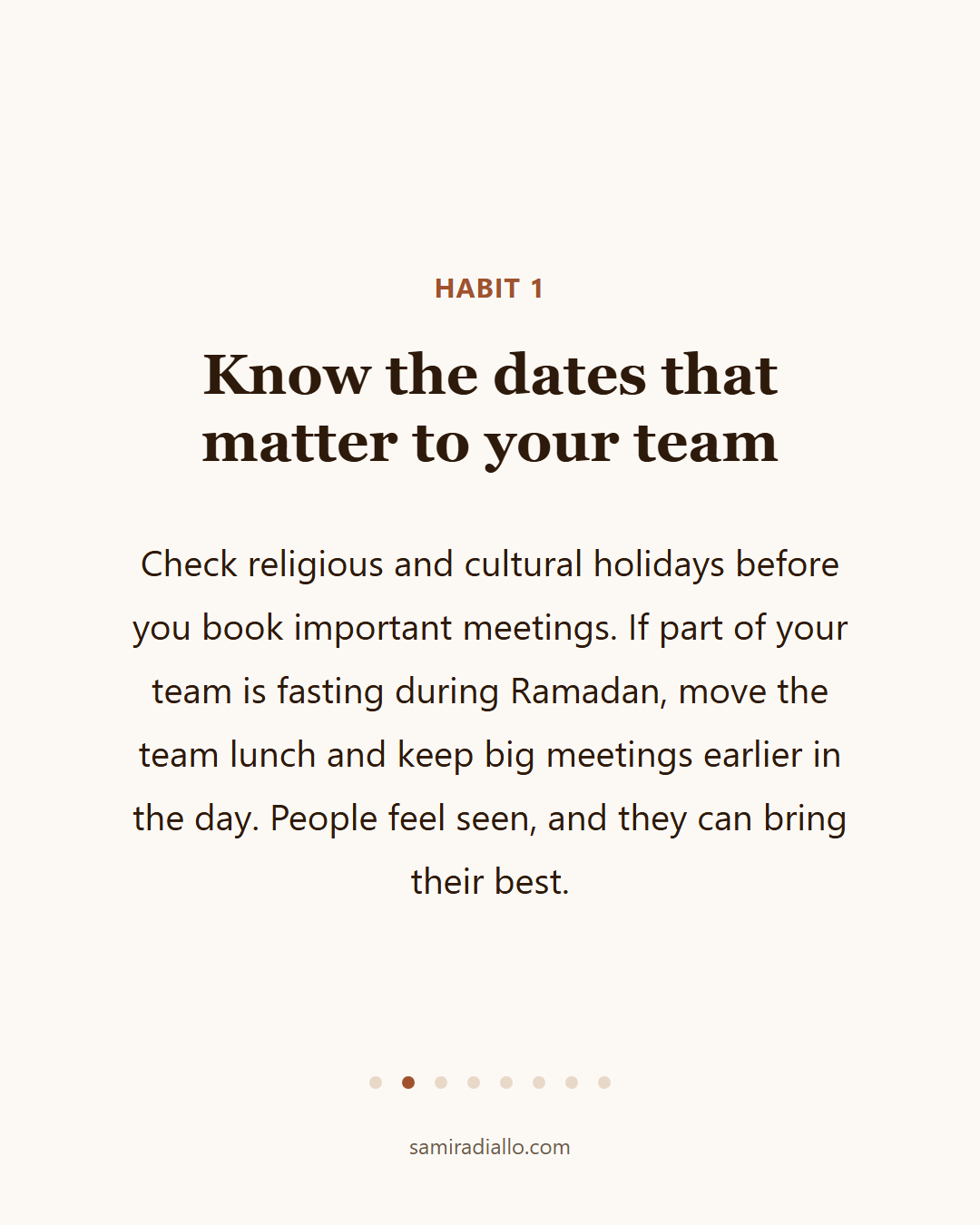
    Habit 1: know the dates that matter to your team

    Your team observes different religious and cultural dates: Ramadan, Diwali, Lunar New Year, Yom Kippur, Christmas, and many more. When an important meeting lands on one of those days, part of your team cannot give it their full attention.

    How to put it into practice:

    • At the start of the year, add the main religious and cultural dates to your team calendar. Ask your team which dates matter to them, and add those too.
    • Before you book an important meeting, a launch or a team event, check the calendar first.
    • If part of your team is fasting during Ramadan, move the team lunch to another week, and keep the big meetings earlier in the day.

    2. Respect people’s time outside work

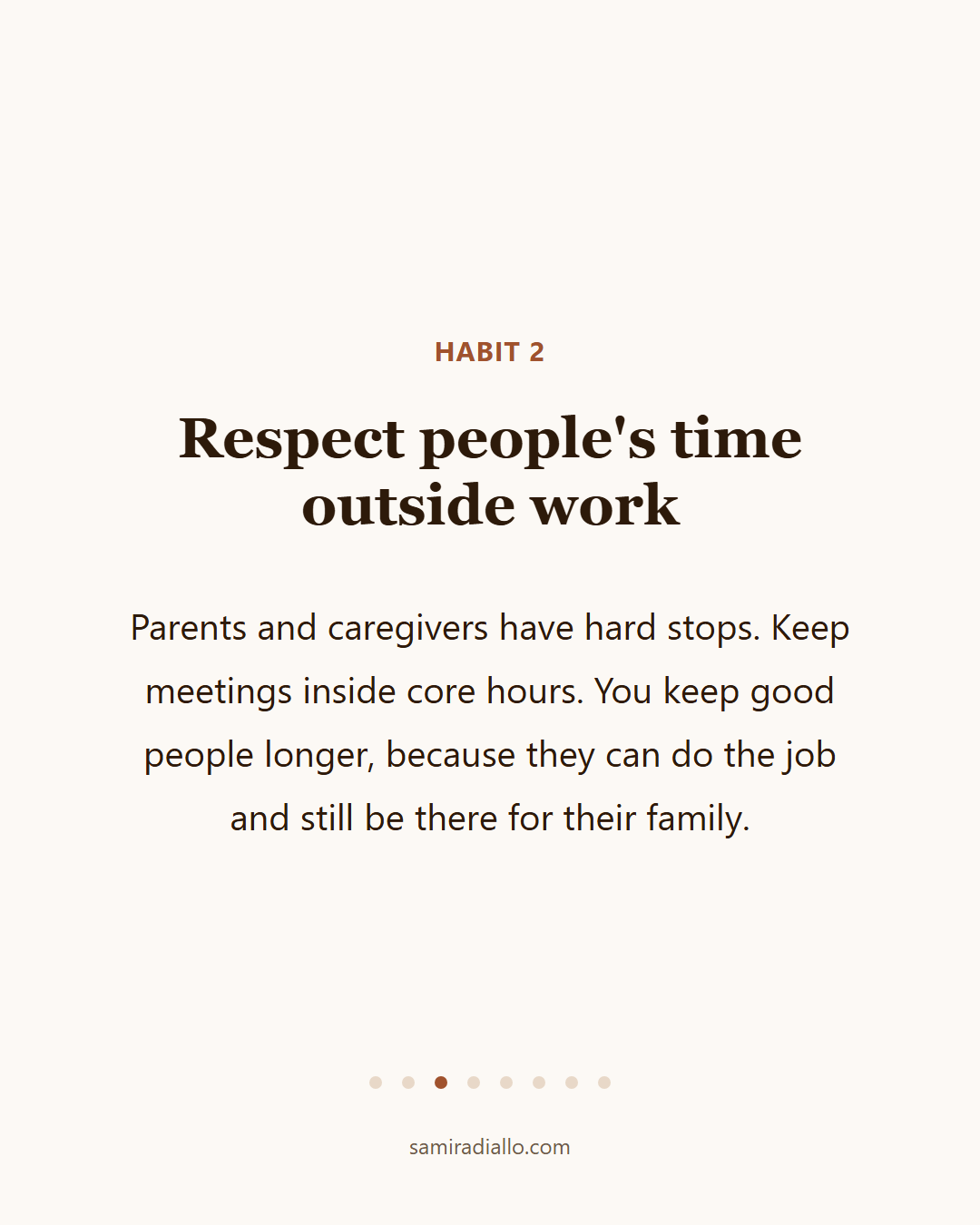
    Habit 2: respect people's time outside work

    Some people on your team have to pick up their kids, care for a parent, or have another commitment after work. They need clear hours. When meetings run late, the same people miss them, and over time they miss the decisions too.

    How to put it into practice:

    • Agree on core hours with your team, and keep team meetings inside them.
    • End meetings on time, and send a short written summary of what was decided.
    • When someone shares a hard stop, respect it.

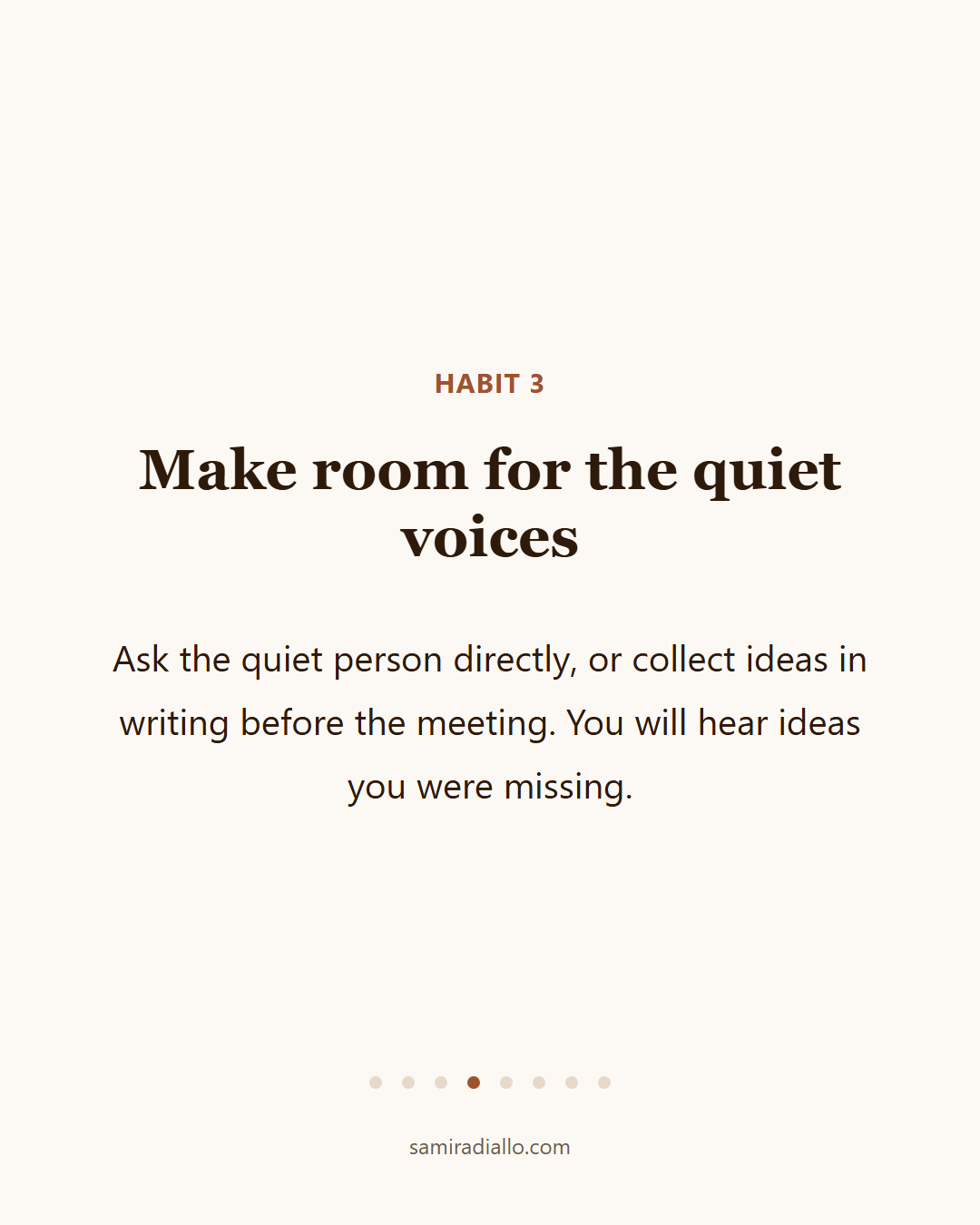
    3. Make room for the quiet voices

    Habit 3: make room for the quiet voices

    In every meeting, some people speak first and speak often. Others prefer to think before they speak, or are working in their second language. When a leader only hears the first voices, the team loses part of its ideas.

    How to put it into practice:

    • Send the agenda and the main question before the meeting, so people can prepare.
    • Ask the people who have not spoken yet what they think, and give them time to answer.
    • Collect ideas in writing, in a shared document or a chat, before you discuss them out loud.

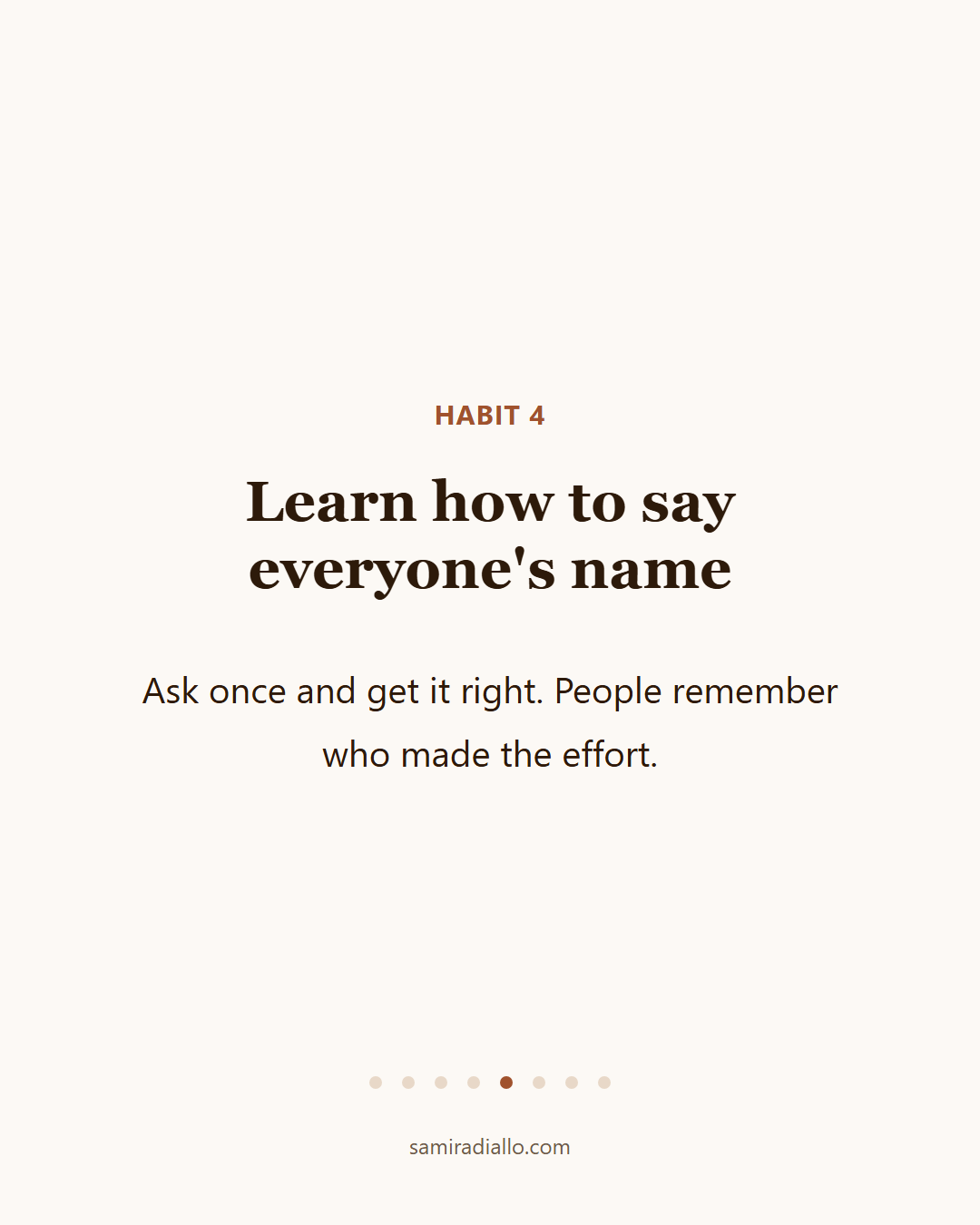
    4. Learn how to say everyone’s name

    Habit 4: learn how to say everyone's name

    A name is part of who someone is, and people hear it many times a day at work.

    How to put it into practice:

    • Ask once how to say the person’s name, then repeat it back.
    • Write it down the way it sounds, in your notes or in your phone.
    • If you get it wrong, say sorry, correct yourself and move on.

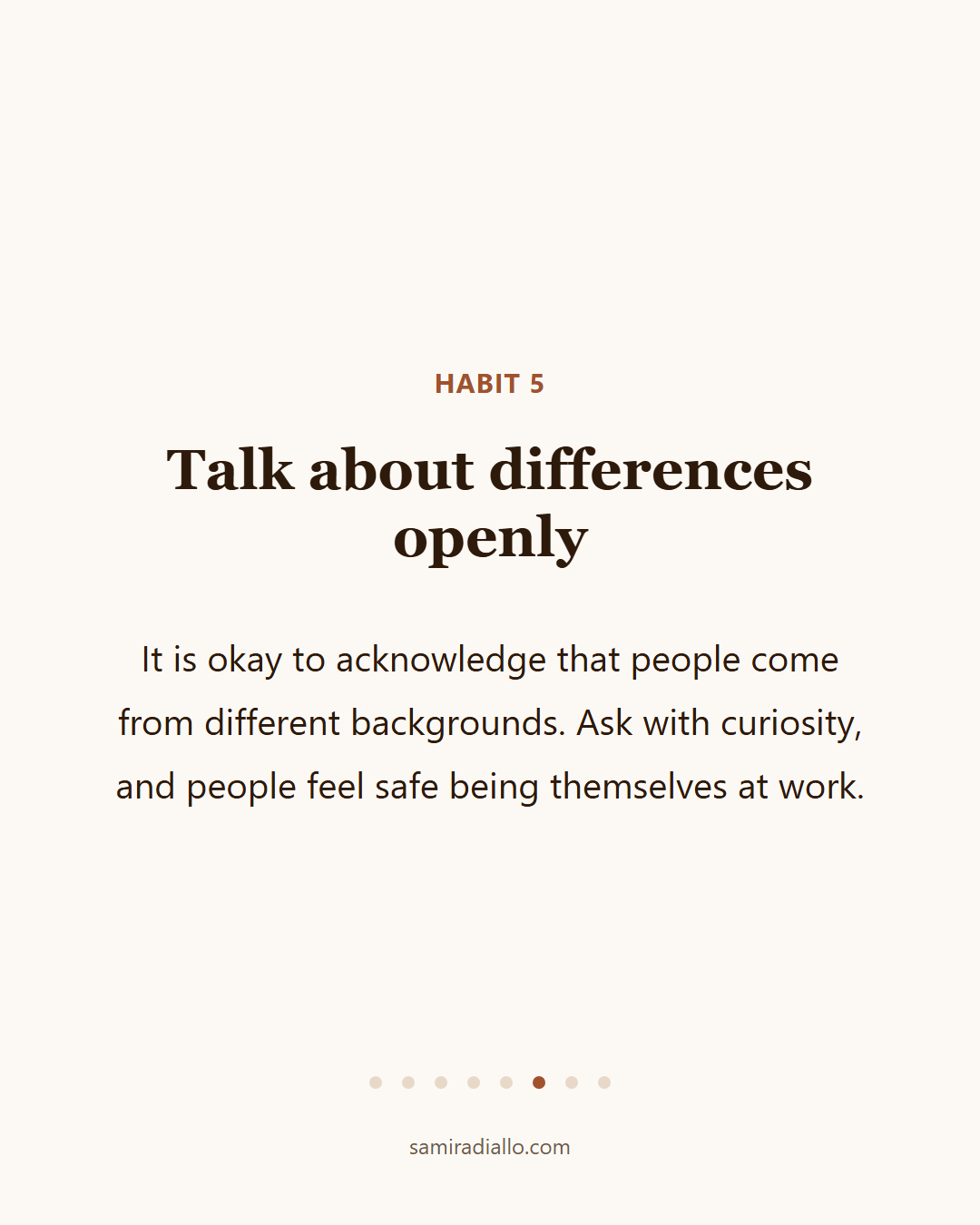
    5. Talk about differences openly

    Habit 5: talk about differences openly

    Your team comes from different countries, cultures, generations and family situations. It is okay to say it out loud. When leaders show real interest, people feel safe being themselves at work.

    How to put it into practice:

    • Ask with curiosity: “What does this holiday mean to you?” or “How do you like to get feedback?”
    • Ask each person how they like to work and communicate, and let them tell you.
    • When someone shares something about their culture or their life, listen, and thank them.

    Why this matters for founders

    Why these habits matter

    People stay where they feel they belong. When your best people feel seen, they share more ideas, they do their best work, and they stay. Every person who leaves takes their knowledge and their client relationships with them, and you pay to hire and train someone new.

    Pick 1 habit and start with it this week.

    If you want the employee side of this story, read How do you navigate all the different parts of who you are at work?

    Building a team where your best people stay? Book a call

    Building a team where your best people stay? Book a call.

    Samira Diallo

    About the author

    Samira Diallo

    Samira Diallo is a bilingual (French and English) people strategy advisor, facilitator and speaker based in Toronto. She spent 15+ years in global tech consulting at Capgemini and Oracle, leading technology projects and the people side of the teams delivering them. Today, she helps companies keep their best people and coaches professionals building the career that works for them.
    ← All insights

  • What a people audit actually looks like

    What a people audit actually looks like

    Retention

    When a founder asks me what a people audit actually involves, this is the answer.

    Why do a people audit

    When turnover climbs or hiring starts to feel harder, the cause is often spread across several places. A people audit looks at the whole picture, so you fix the real problem and stop guessing.

    The 5 areas I look at

    • Hiring. How long it takes, who decides, and what happens between the offer and day 1. Slow or unclear hiring loses good candidates to faster companies.
    • Onboarding. What a new person gets in week 1, and who owns them in month 3. The first months shape whether someone settles in or starts looking again.
    • Performance. Whether managers are having the hard conversations, and what happens when someone is below the bar. Avoided conversations cost you the respect of your strongest people.
    • Retention. Who left in the last 18 months, and what they actually said on the way out. Exit reasons show you where to act first.
    • Pay. Whether 2 people doing the same job are paid the same, and whether you can explain the difference. Unexplained gaps create risk and damage trust.

    I look at how these run in practice. What the policy document says is a separate question, and usually a different answer.

    What you get

    You end up with a short list: what is costing you money, and what to fix first. Your next people decision is then based on what is really happening in your company.

    Signs it is time for a people audit

    • Turnover is climbing and nobody can tell you exactly why
    • Managers handle the same people issue in different ways
    • The team grew fast and your processes stayed the same

    3 questions to ask yourself today

    • Could I explain why the last 3 people who resigned left?
    • Does every new hire get the same first week, whoever their manager is?
    • If an employee asked how their pay was set, could I answer clearly?

    If any of these was hard to answer, that is where an audit starts.

    If turnover is climbing and nobody can tell you exactly why, book a call.

    Samira Diallo

    About the author

    Samira Diallo

    Samira Diallo is a bilingual (French and English) people strategy advisor, facilitator and speaker based in Toronto. She spent 15+ years in global tech consulting at Capgemini and Oracle, leading technology projects and the people side of the teams delivering them. Today, she helps companies keep their best people and coaches professionals building the career that works for them.
    ← All insights

  • The 5 facilitation sessions organizations ask for most

    The 5 facilitation sessions organizations ask for most

    Facilitation

    A session works when people leave with something they can act on Monday.

    That is what I am hired to run. These are the 5 sessions organizations ask for most, who each one is for, and what people leave with.

    1. Leadership development

    For managers who were promoted because they were good at the work and are now responsible for people. They leave with a clearer picture of their new role, simple ways to give feedback, and a plan for their next 1 on 1s.

    2. Team sessions

    For when something is not being said out loud and the team has started working around it. People leave having named the issue together, with agreements on how they will work from now on.

    3. Career and progression workshops

    So people know what growth looks like here and how to ask for it. Participants leave knowing the paths open to them and how to start that conversation with their manager.

    4. Women’s leadership programs

    Covering presence, visibility and negotiation. Participants leave with practical tools they can use in their next meeting, their next review and their next salary conversation.

    5. Strategy and planning days

    Sessions that end with decisions. The group leaves with clear priorities, owners and next steps written down.

    How to get the most from a session

    • Start with the problem. Tell your facilitator what is happening and what you want to be different after the session. Why: the agenda is built around your outcome.
    • Invite the right people. The people who will act on the decisions need to be in the room. Why: decisions stick when the people doing the work helped make them.
    • Plan the follow-up before the day. Book a short check-in 2 to 4 weeks later. Why: this is where commitments turn into action.

    How I work in the room

    I run sessions in English and in French, in person and online.

    My job in the room is to get people talking to each other, keep it on track, and get you to that Monday.

    If you have a group, a problem and a date, book me.

    Samira Diallo

    About the author

    Samira Diallo

    Samira Diallo is a bilingual (French and English) people strategy advisor, facilitator and speaker based in Toronto. She spent 15+ years in global tech consulting at Capgemini and Oracle, leading technology projects and the people side of the teams delivering them. Today, she helps companies keep their best people and coaches professionals building the career that works for them.
    ← All insights

  • 73% of employees would stay longer if you invested in their growth

    73% of employees would stay longer if you invested in their growth

    Learning and development

    73% of employees say they would stay longer if their company invested more in their growth.

    If you are a founder or business owner growing your team, that number should matter to you. Hiring gets you the people. Developing them is what keeps them.

    Why growth keeps people

    • People stay where they can see a future. When the next step is clear, they have a reason to build it with you.
    • Growth builds confidence. A person who is learning brings more ideas and takes on more responsibility.
    • It fills your own pipeline. The leaders you need in 2 years can come from the team you have today.

    Learning and development for a growing company

    You do not need a big budget or a training department to start. Development in a growing company can be simple:

    • Stretch projects with support from a manager
    • Mentoring between senior and junior people
    • Learning budgets people can use for a course or a conference
    • Short internal sessions where people teach what they know
    • Leadership training for new managers

    5 steps to start this quarter

    1. Ask each person what they want to learn next. Why: the best plan starts from what people actually want.
    2. Write down what growth looks like for each role. Why: people can only aim for a next step they can see.
    3. Add a development question to every 1 on 1. Why: it keeps growth part of the regular conversation.
    4. Give every manager a small budget or time allowance for development. Why: managers can act quickly when someone is ready.
    5. Check in every 6 months on who has grown and who has stalled. Why: someone who has stalled may already be looking elsewhere.

    What I have seen work

    In my corporate roles, I grew a leadership program to more than 1,000 attendees across 20+ global offices. I also designed and led an entry-level career program for women in tech. Both showed me how much people value a clear path forward.

    Learning and development is how you build a company people want to stay and grow in.

    If this feels like a gap in your company, reach out. This is exactly the kind of work I do with founders and leadership teams.

    Samira Diallo

    About the author

    Samira Diallo

    Samira Diallo is a bilingual (French and English) people strategy advisor, facilitator and speaker based in Toronto. She spent 15+ years in global tech consulting at Capgemini and Oracle, leading technology projects and the people side of the teams delivering them. Today, she helps companies keep their best people and coaches professionals building the career that works for them.
    ← All insights