Women in tech
English
34.8% of women work in Canada’s digital economy. Only 9% reach leadership roles.
That is not a talent gap. That is a systems gap.
What a systems gap looks like
The women are there. The drop happens on the way up, in the everyday systems that decide who moves forward:
- Hiring. Who writes the job descriptions, who sits on the interview panel, and what counts as the right profile.
- Promotion. Whether the criteria are written down, or decided in rooms where some people are present and others are not.
- Sponsorship. Who gets the visible projects and who gets named when a leadership role opens.
None of these depend on talent. They depend on how the organization is built, and that means they can be changed.
5 things an organization can do this year
- Look at your numbers by level. Count women at each step from entry level to leadership. Why: the step where the number drops is where to act first.
- Write down your promotion criteria. Why: clear criteria make the decision fairer and easier to explain.
- Use a mixed interview panel. Why: different people notice different strengths.
- Pair high-potential women with sponsors, senior leaders who will put their name forward. Why: mentors give advice, sponsors open doors.
- Check who gets the visible projects. Why: visible work is often what leads to the next role.
A free tool to start
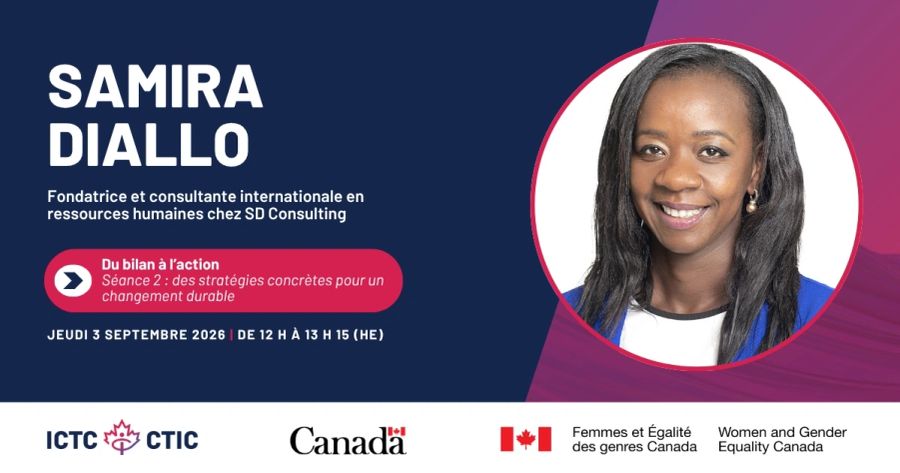
I facilitated the first French session of ICTC’s “Advancing Women’s Leadership” program, alongside Farzeen Foda for the English version.
ICTC’s Equitable Leadership Assessment Tool is free, bilingual, and takes about 20 minutes. It evaluates 4 areas (leadership accountability, talent acquisition, career mobility, and workplace experience) and gives you concrete recommendations tailored to your organization.
Tool: etalentcanada.ca/equitable-leadership-assessment
If you want help turning the results into a plan, send me a message.
Français
34,8% des femmes travaillent dans l’économie numérique canadienne. Seulement 9% se retrouvent aux postes de direction.
Ce n’est pas un manque de talent. C’est un manque de systèmes.
J’ai animé la première séance en français du programme « Promouvoir le leadership des femmes » du CTIC, aux côtés de Farzeen Foda pour la version anglaise.
L’outil d’évaluation du leadership équitable du CTIC est gratuit, en français, et prend environ 20 minutes. Il évalue 4 domaines clés (responsabilité, recrutement, mobilité de carrière et expérience en milieu de travail) et vous donne des recommandations concrètes adaptées à votre organisation.
Outil : etalentcanada.ca/equitable-leadership-assessment

Samira Diallo
Bilingual (French/English) people strategy advisor, facilitator and speaker based in Toronto. 15+ years in global tech consulting at Capgemini and Oracle, on the tech project side and the people side.